The best CS2 cases to open in 2026 are the Chroma 2 Case, the Prisma Case, and the Chroma 3 Case: CS:GO-era containers that, per CSGOFast case statistics as of August 2026, still return more value per dollar than anything Valve has shipped since. Want the cheapest ticket instead? The Kilowatt Case opens for $2.72, key included, and nothing in the game beats that. In this guide we break down why decade-old cases outperform the new ones, what ROI (Return on Investment) really means, where your knife odds pay off best, and the honest math the opening animation will never show you.
Key Takeaways
- Drop odds are identical in every case: 0.26% for a knife or gloves, 0.64% for a Covert, 79.92% for a blue skin.
- No case clears 100% ROI, so over any real number of openings you hand over more than you get back.
- Discontinued cases win because their knives keep appreciating while no new copies enter the game.
How Case Opening Works in CS2
A weapon case in Counter-Strike 2 (CS2) holds a set of weapon skins across several rarity tiers plus rare special items: knives or gloves. Opening one takes the case plus a case key ($2.49 from Valve), and that sum is the opening price we use throughout.
Cases come from three sources:
- Weekly drops – Prime-status players pick cases from the active drop pool in the weekly care package.
- The Steam Community Market – every case below can be bought directly, including discontinued ones.
- The Armory – newer containers like the Fever Case and Gallery Case arrived through this system.
Case drop odds are fixed everywhere, per Valve’s official disclosure: Mil-Spec (blue) 79.92%, Restricted (purple) 15.98%, Classified (pink) 3.20%, Covert (red) 0.64%, and rare special items 0.26%, roughly 1 in 385 openings. So four times out of five, you get a blue skin worth less than the key you just spent. All the value sits in the remaining 20%, and the rankings below show where that fifth pays off best.
In game, those percentages never move. On CSGOFast your odds of coming out ahead are better, with both the classic cases you know from Counter-Strike 2 and original sets that don’t exist in game.
What Does ROI Mean in CS2 Case Opening?
ROI (Return on Investment) measures how much case value an average opening returns compared to its cost:
ROI = (average value of each item in the case) ÷ (cost of the case + cost of opening) × 100
An ROI of 89.16% means every $1.00 spent on the Chroma 2 Case returns $0.89 in skin value on average. No case exceeds 100%: over thousands of openings, every case returns less than it costs, but high ROI shows which cases waste the least money and carry the strongest jackpots for their price.
Keep in mind that ROI is an average across a huge sample, not a forecast for your session. Your particular opening either pulls a knife and covers the last hundred tries, or lands in that 80% pile of blue skins. The average is built from those two extremes, not from a tidy 89 cents every time.
From what we’ve tracked as of August 2026, CS2 case ROI sits roughly between 41% (Fracture Case) and 89% (Chroma 2 Case). That’s a wide spread: picking the right case nearly doubles your expected return.
Most Profitable CS2 Cases by ROI
Prices are in USD at Steam Community Market value, key included. Data: CSGOFast case statistics, as of August 2026.
| # | Case | ROI | Opening Price | Return Range |
| 1 | Chroma 2 Case | 89.16% | $7.78 | $0.31 – $11,311.35 |
| 2 | Prisma Case | 86.89% | $4.62 | $0.20 – $4,370.73 |
| 3 | Chroma 3 Case | 83.75% | $7.46 | $0.21 – $11,311.35 |
| 4 | Gamma Case | 78.91% | $6.81 | $0.29 – $11,730.00 |
| 5 | Chroma Case | 76.01% | $9.66 | $0.43 – $11,311.35 |
| 6 | Gamma 2 Case | 75.63% | $6.99 | $0.10 – $11,730.00 |
| 7 | Fever Case | 74.13% | $3.38 | $0.06 – $5,152.81 |
| 8 | Prisma 2 Case | 74.06% | $4.52 | $0.09 – $4,370.73 |
| 9 | Spectrum 2 Case | 72.44% | $6.88 | $0.14 – $17,340.00 |
| 10 | Spectrum Case | 69.08% | $8.03 | $0.18 – $17,340.00 |
Return Range = the value of the cheapest and the most expensive item you can pull.
1. Chroma 2 Case – 89.16% ROI
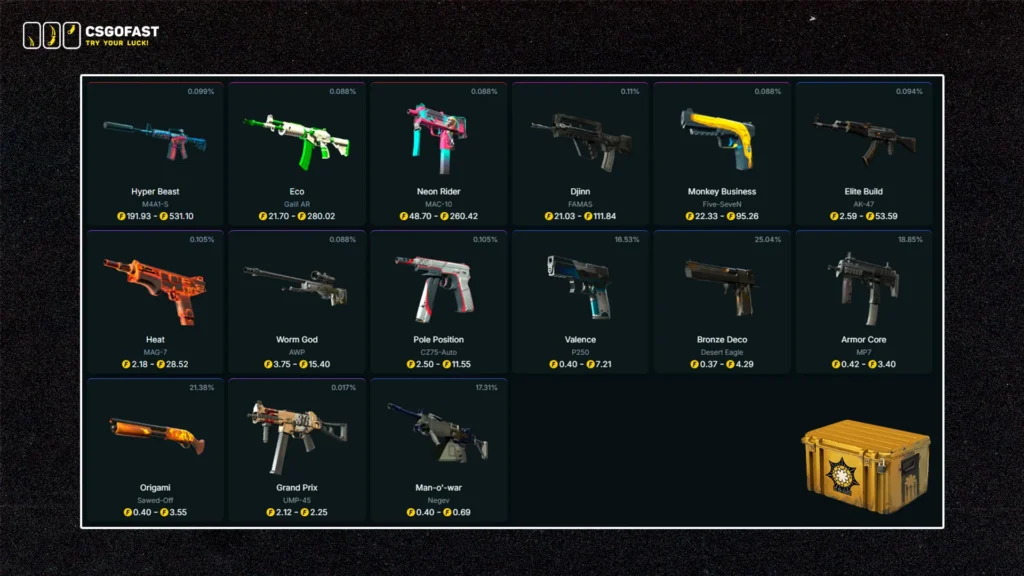
Released April 15, 2015 with the “Chromatic Scale” update, this is the case that taught the market to care about Doppler. The rare-special pool covers five classic models: Bayonet, Flip Knife, Gut Knife, Karambit and M9 Bayonet. Hidden inside the Doppler finish are the Ruby, Sapphire and Black Pearl phases, which sell for several times what a standard Phase 1-4 goes for.
Its weapon lineup is smaller than a modern case’s but lands harder: both Coverts have held their value for a decade, which is rare for a container this old. An expensive knife pool plus Coverts that never crashed is the whole formula behind first place.
2. Prisma Case – 86.89% ROI
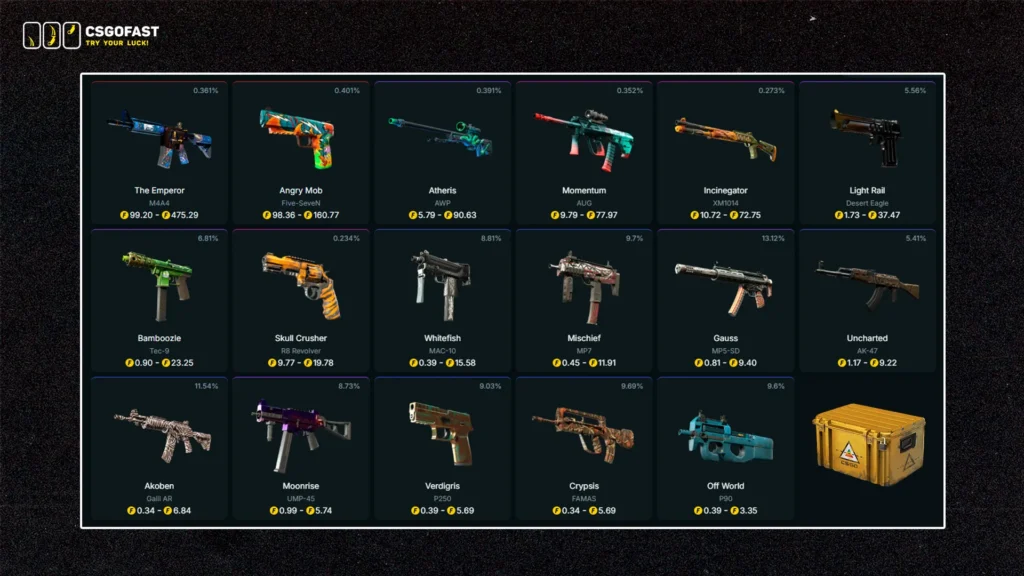
Released March 13, 2019, it gave the game four new knife models at once: Talon, Ursus, Stiletto and Navaja. It’s a rare case that earns its ROI from an even pool rather than a single trophy blade.
Even the budget Navaja and Ursus hold their value here, so the average knife pull lands well above what you’d get from a case built on one star and four duds. If you open in runs, that difference matters: the whole pool pays, not just the one lucky outcome.
3. Chroma 3 Case – 83.75% ROI
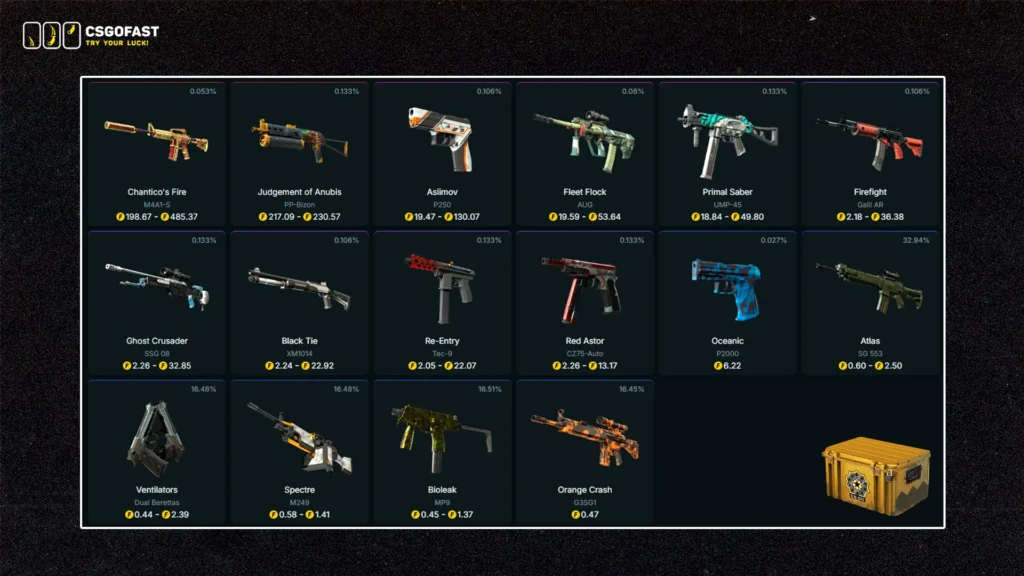
Released April 27, 2016, it works as a cheaper door into the same knife pool as Chroma 2: same five models, same finishes, same return ceiling.
The only difference is the weapon tier, which trades lower and drags the case price down with it. For a knife hunter that’s simple arithmetic: identical odds on the blade, less money per attempt. The one reason to pick Chroma 2 instead is wanting something worth keeping in the consolation 20%.
4. Gamma Case – 78.91% ROI
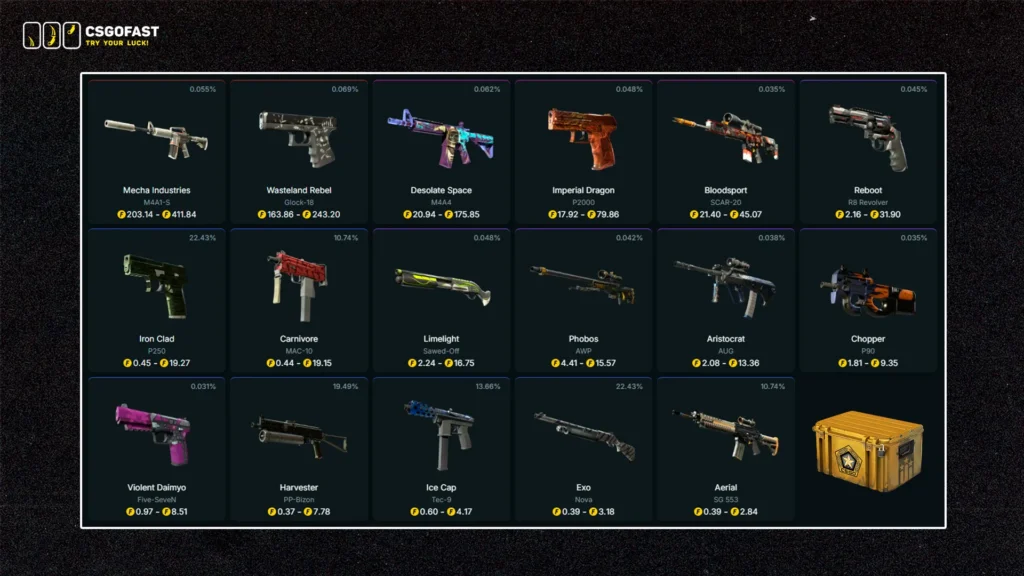
Released June 15, 2016, it introduced a whole family of finishes: Gamma Doppler, Lore, Autotronic, Black Laminate, Bright Water and Freehand. It was the second big wave of premium knife finishes after Chroma, applied to the same five blade models: Valve lifted the market again without adding a single new knife to the game.
Its lasting mark on the economy is the Emerald phase of Gamma Doppler. That pure green variant became the most expensive version of the finish and still ranks among the priciest items in the game, which is exactly what sets the return ceiling you see in the table.
5. Chroma Case – 76.01% ROI
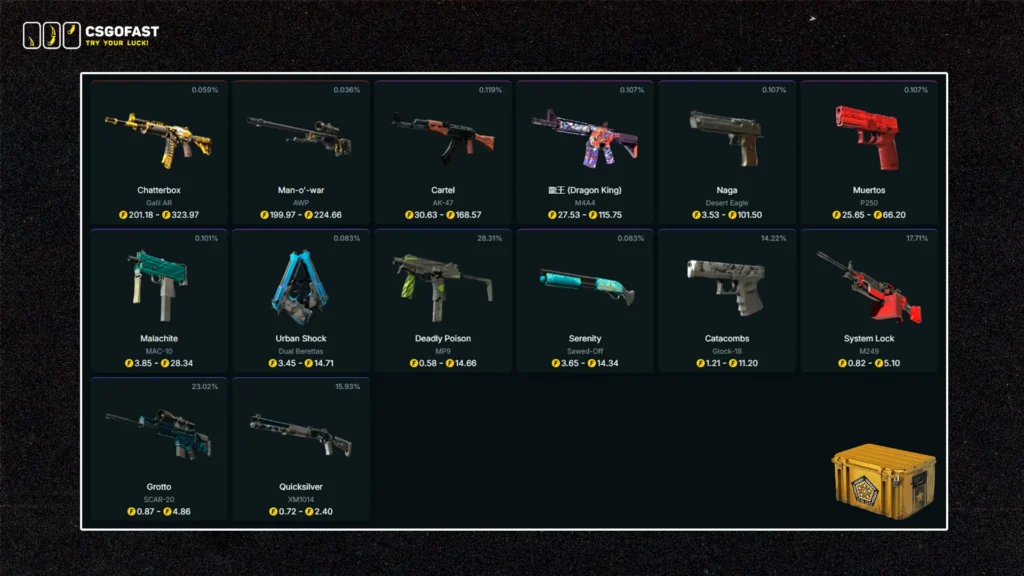
Released January 8, 2015, this is where all of it started. Before Chroma, knives existed only in plain finishes; this case brought Doppler, Marble Fade, Tiger Tooth, Damascus Steel, Ultraviolet and Rust Coat. The skin market as we know it begins roughly here.
It’s the priciest opening in this ranking, since the case left the drop pool long ago and trades accordingly. The weapon tier holds up better than you’d expect from 2015: both Coverts still have their own following rather than sitting at floor prices.
6. Gamma 2 Case – 75.63% ROI
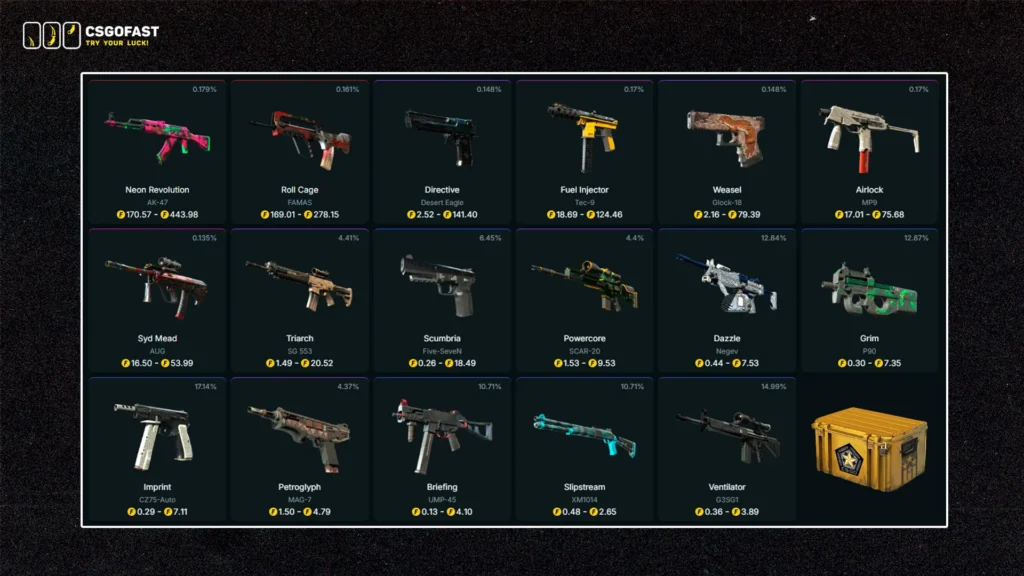
Released August 18, 2016, it repeats the Gamma Case formula: same finish family, same return ceiling, noticeably stronger weapon lineup.
If you want decent odds at an expensive knife plus something worth keeping in the 80% of ordinary pulls, this is the smarter of the two Gamma cases. The opening price is nearly identical, so the difference shows up entirely in the consolation drops.
7. Fever Case – 74.13% ROI
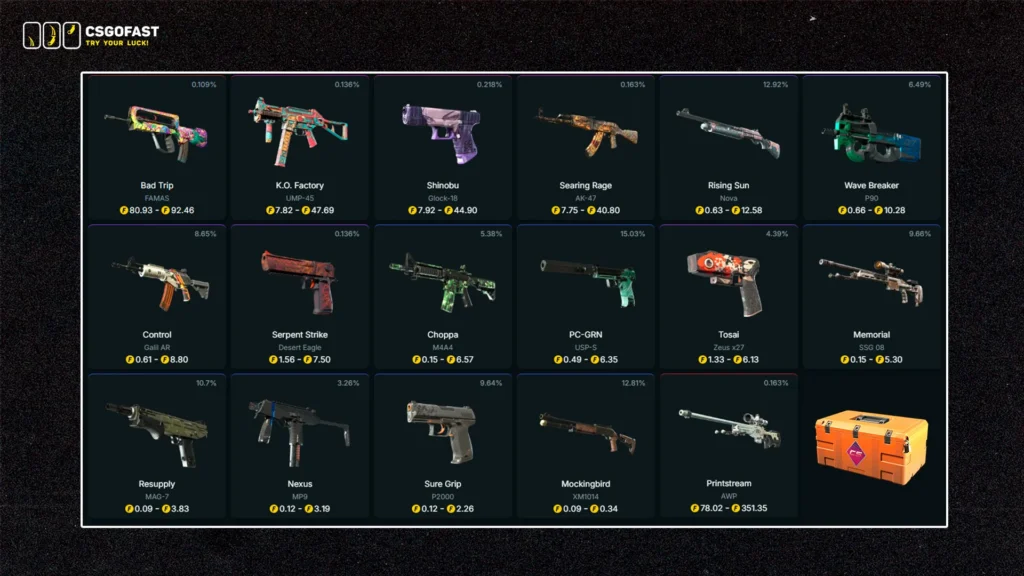
Released March 31, 2025 with the Spring Forward update, it’s the newest container anywhere near the top of the ROI chart. Its value rests on bringing the Shattered Web knives – Skeleton, Nomad, Paracord and Survival – back in Chroma finishes, a pairing collectors had been asking for since 2019.
One thing to know if you were hoping to earn it for free: Fever arrived through the Armory system rather than the weekly drop pool. No amount of playing will get you one, so buying is the only route.
8. Prisma 2 Case – 74.06% ROI
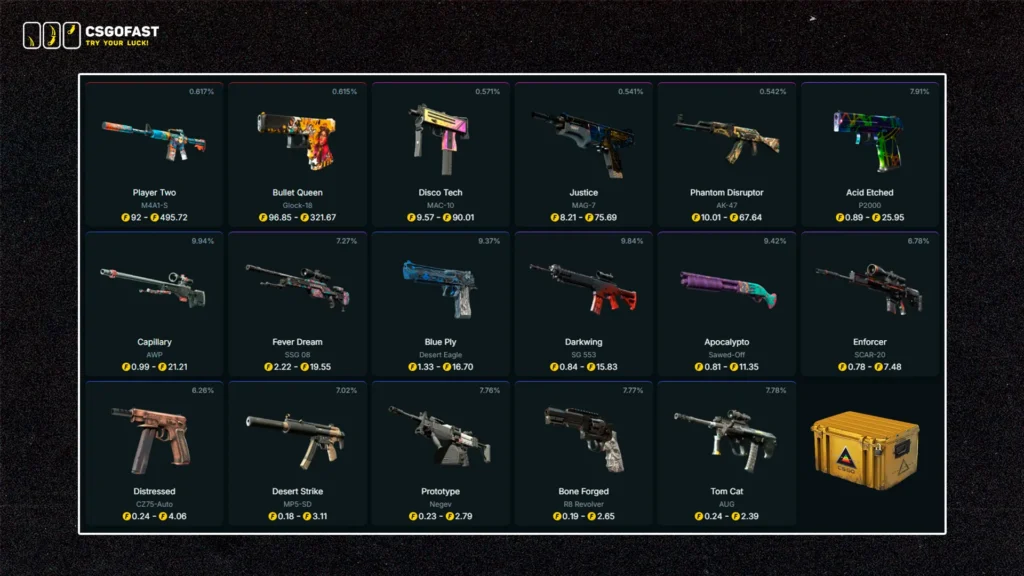
Released March 31, 2020, it shares its knife pool with the original Prisma Case: the same Talon, Ursus, Stiletto and Navaja.
The gap is in the weapons, where this tier trades lower, which makes the case cheaper and costs it a few ROI points. It’s the same bet on knives that Prisma offers, with slightly thinner insurance when the drop comes back ordinary.
9. Spectrum 2 Case – 72.44% ROI
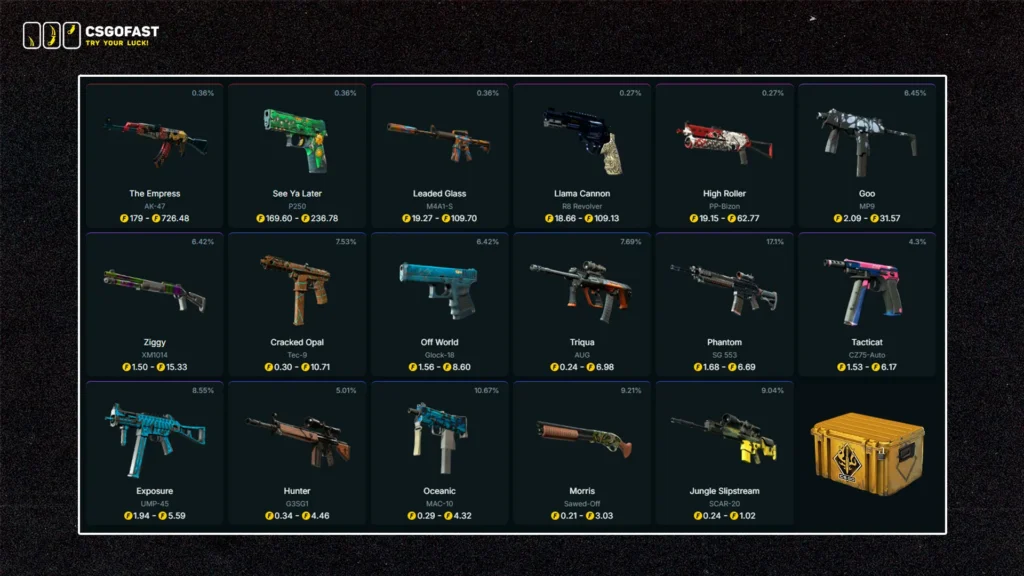
Released September 14, 2017, it holds the highest return ceiling in this article, and the reason has a name: the Butterfly Knife.
The Butterfly is still the most expensive knife model in the game. Its deployment animation made it a status item back in the CS:GO days, and in Doppler or Marble Fade it sells for the price of a used car. Everything else in the case is a bonus next to that.
10. Spectrum Case – 69.08% ROI
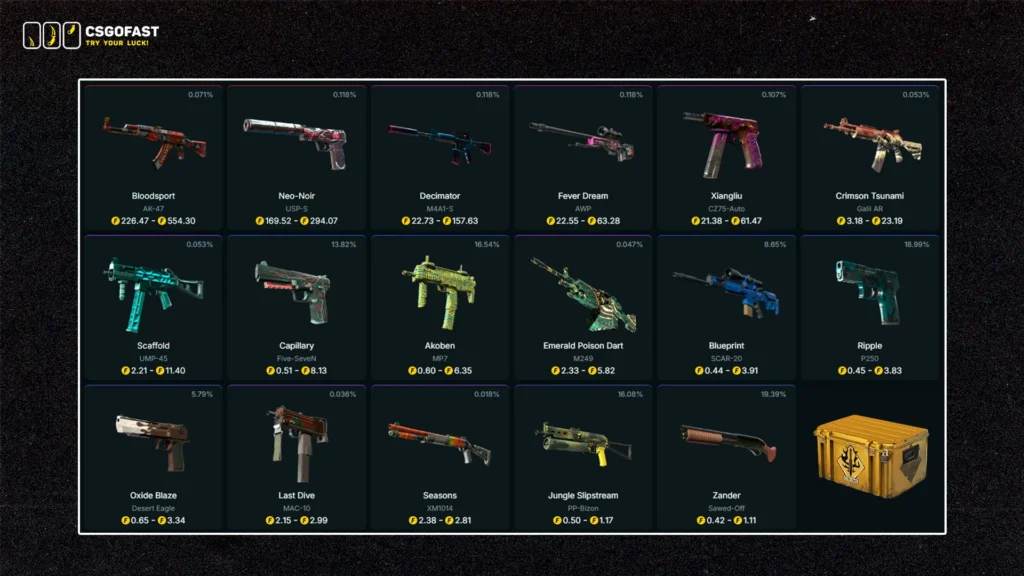
Released March 15, 2017, it was the first case to give the Butterfly Knife its Chroma finishes, back when the Butterfly existed in far plainer form.
It shares Spectrum 2’s ceiling, and its weapon roster is arguably the strongest in this ranking: both Coverts became the reference finish for their weapon and still sit high on popularity charts years later. The higher opening price is the only real argument against it.
Cheapest CS2 Cases to Open
Opening price means case plus the $2.49 key. Data: CSGOFast case statistics, as of August 2026.
| # | Case | Opening Price | ROI | Return Range |
| 1 | Kilowatt Case | $2.72 | 42.61% | $0.04 – $1,423.41 |
| 2 | Revolution Case | $2.86 | 50.45% | $0.05 – $7,287.49 |
| 3 | Recoil Case | $3.00 | 52.23% | $0.05 – $3,126.72 |
| 4 | Snakebite Case | $3.17 | 65.14% | $0.18 – $3,126.72 |
| 5 | Fracture Case | $3.28 | 41.27% | $0.05 – $2,981.48 |
| 6 | Fever Case | $3.38 | 74.13% | $0.06 – $5,152.81 |
| 7 | Clutch Case | $3.43 | 47.09% | $0.08 – $7,287.49 |
| 8 | Gallery Case | $3.67 | 56.78% | $0.15 – $1,423.41 |
| 9 | CS20 Case | $4.01 | 51.87% | $0.20 – $986.29 |
| 10 | Dreams & Nightmares Case | $4.18 | 68.66% | $0.06 – $10,988.17 |
Cheap cases are mostly recent, still dropping weekly, with ROI 20 – 40 points below the discontinued classics: you pay less per pull, you get less back per pull.
If the in-game lineup of cases starts to feel small, CSGOFast runs case battles, where several players open identical cases at the same time and the best haul takes the lot.
1. Kilowatt Case – $2.72 per opening
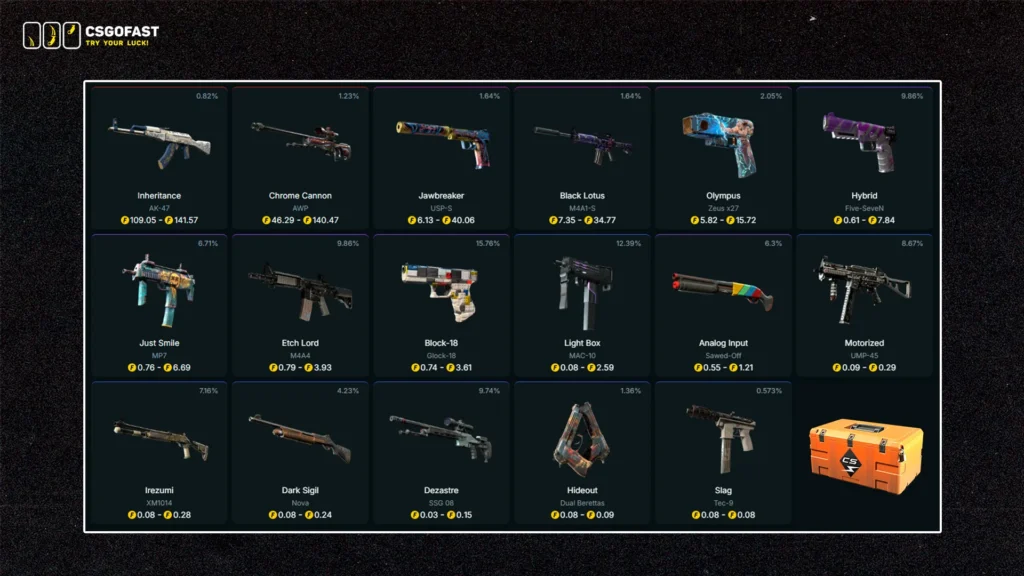
Released February 6, 2024, it goes down as the case that brought Counter-Strike a new knife model for the first time in years: the Kukri Knife. The heavy curved blade with its unfamiliar inspect animation became a chase item immediately.
The case still sits in the active weekly drop pool, so supply keeps growing and the container trades near nothing. The key accounts for almost the entire opening cost, which is how it takes first place on price.
2. Revolution Case – $2.86 per opening
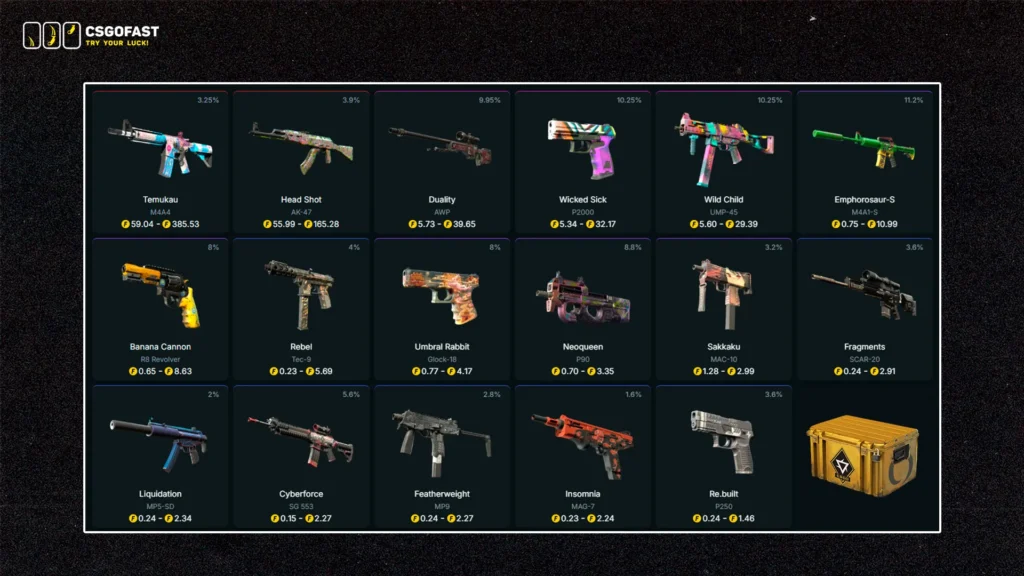
Released February 9, 2023, it was the last major case of the CS:GO era, and it carries one of the few instances of Valve pulling a skin after release: the original Classified AWP finish was swapped for a replacement, with items already in players’ inventories converted automatically.
Its rare specials are Clutch-series gloves rather than knives, and they’re what set the high return ceiling. The case stands out stylistically too – its anime motifs kicked off a whole argument about where the game’s art direction was heading.
3. Recoil Case – $3.00 per opening
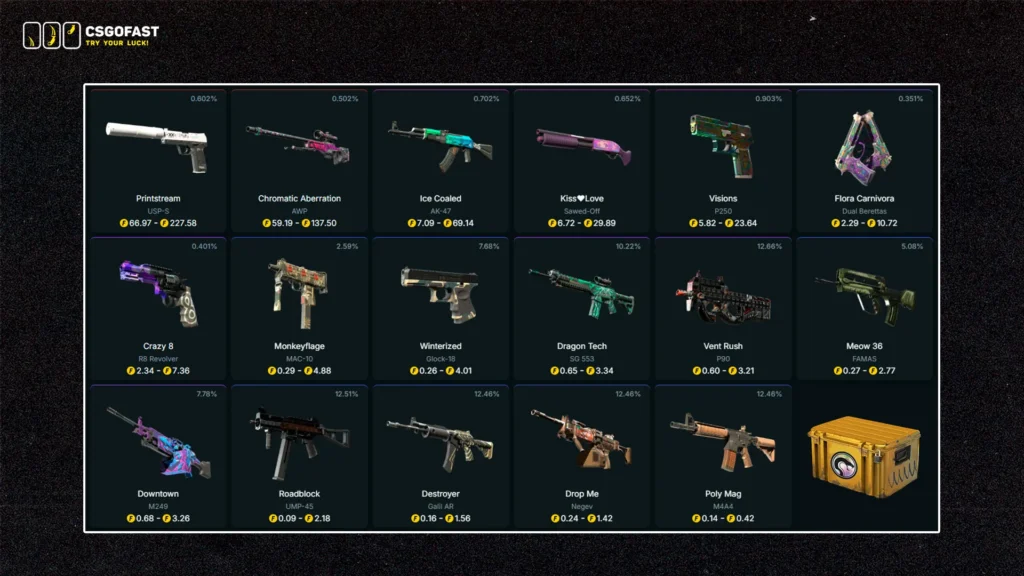
Released July 1, 2022, it closed out the Printstream trilogy by adding the USP-S alongside the M4A1-S and Desert Eagle. For anyone assembling a matched loadout, this was a mandatory case.
Its rare specials are Broken Fang-era gloves, which gives it a solid ceiling at exactly three dollars. The ROI is middling, though: people open this one for a specific goal rather than for the math.
4. Snakebite Case – $3.17 per opening
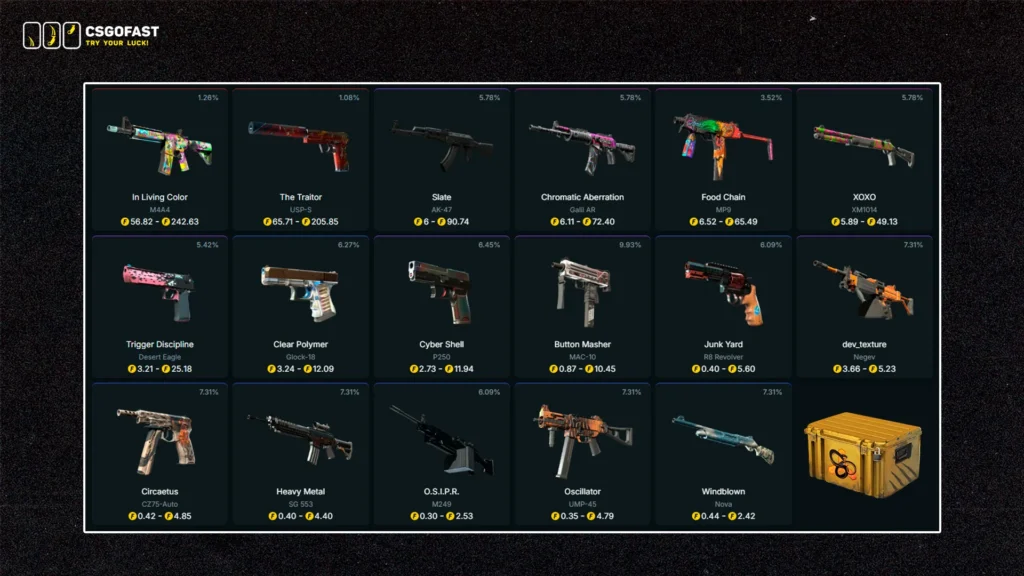
Released May 3, 2021, it’s the most underrated case on this list: at roughly three dollars it offers the best price-to-ROI balance of any cheap container.
The trick is that its value is spread across the pool instead of locked in one jackpot. Even its lower-rarity items trade consistently, while the Broken Fang glove pool supplies the upside. For opening in volume without banking on a miracle, this is the most rational pick in the table.
5. Fracture Case – $3.28 per opening
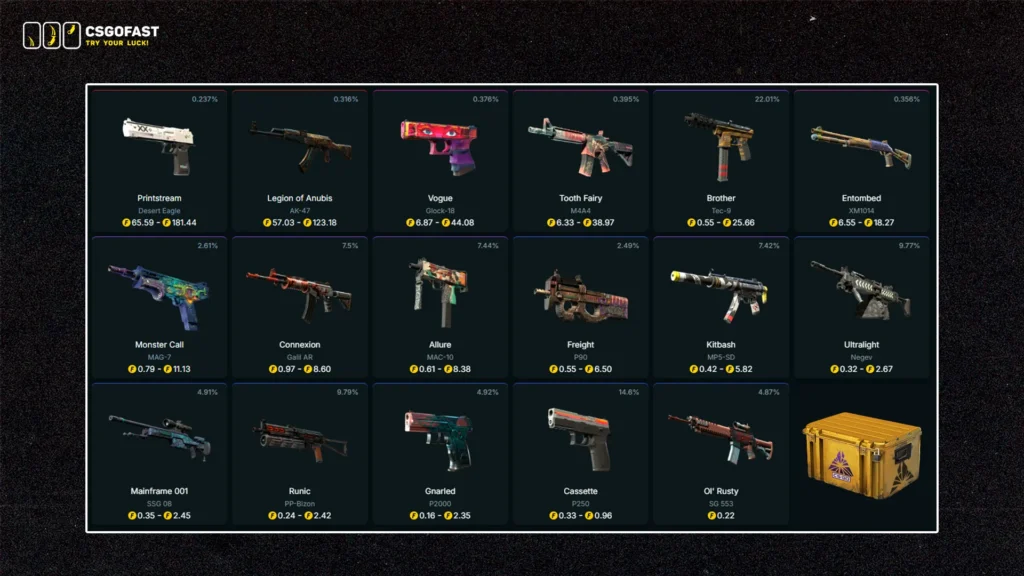
Released August 6, 2020, it was the first to bring the Shattered Web knives – Skeleton, Nomad, Paracord and Survival – into an ordinary case rather than an operation. Before that, they were locked behind Operation Shattered Web.
The price of that is the lowest ROI in this article. The weapon tier trades weakly and nearly all the value sits inside the 0.26% knife slot, so it only makes sense if those blade models are specifically what you’re after.
6. Fever Case – $3.38 per opening
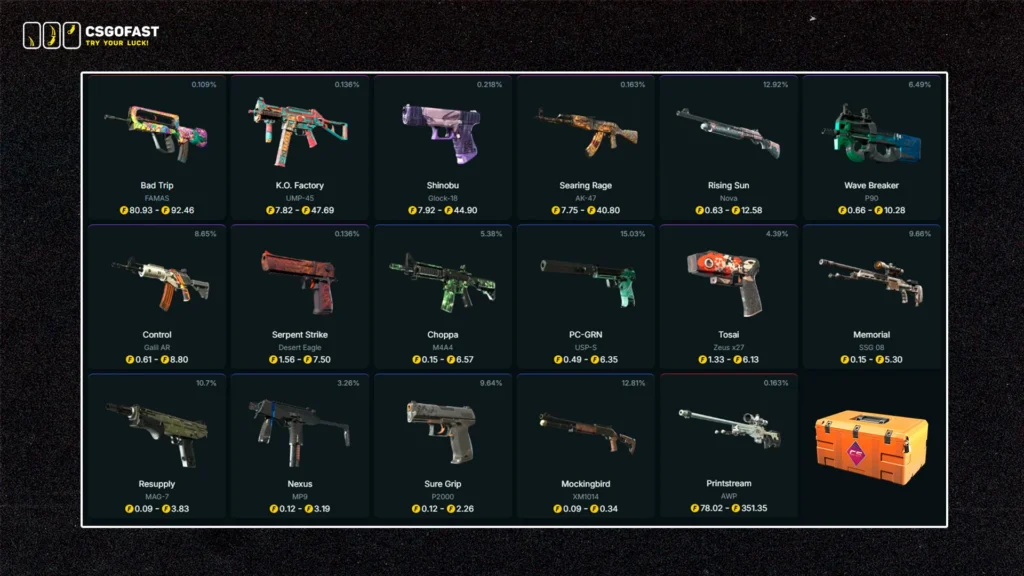
The Fever Case pulls double duty: a cheap entry price with the best ROI in this table. Full breakdown is in the ROI ranking above.
7. Clutch Case – $3.43 per opening
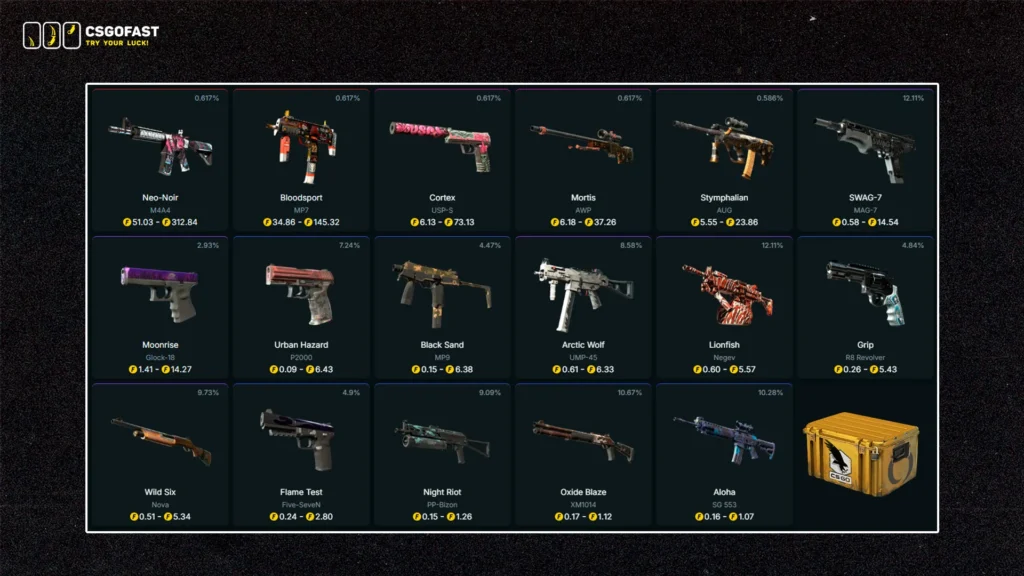
Released February 15, 2018, it created an entire market segment: the Sport, Driver, Specialist, Moto, Hand Wraps and Hydra glove series all debuted here and were reused by later cases.
Before Clutch, gloves were a curiosity from a single Glove Case; after it, they became a collecting category with grails of their own. That pool is where the case’s high ceiling comes from, while the weapon tier is distinctly quieter.
8. Gallery Case – $3.67 per opening
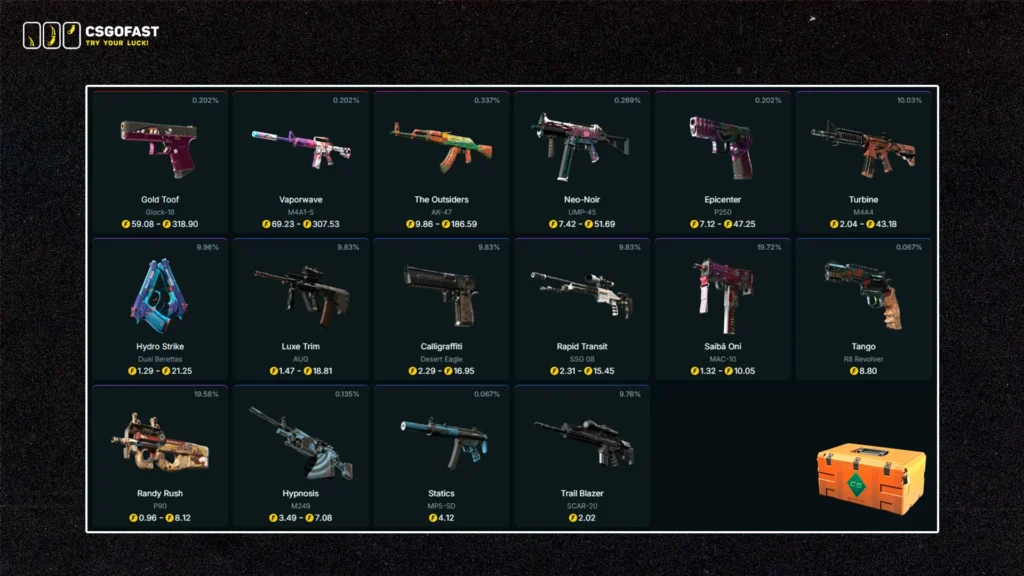
Released October 2, 2024 alongside the Armory update — the one that brought credits, charms and the Armory store into the game. It has since left the weekly care package, though buying it on the market is still easy.
Its rare special is the Kukri Knife across thirteen finishes, including the pattern-dependent Case Hardened, where blue-heavy examples sell for a large multiple of an ordinary one. Among cases that are still easy to get hold of, Gallery has the best ROI.
9. CS20 Case – $4.01 per opening
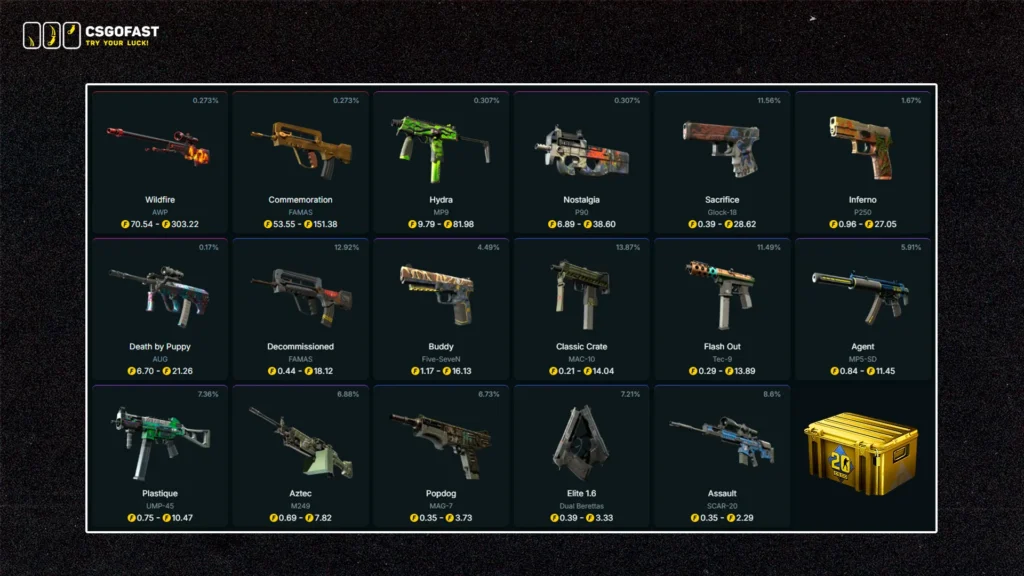
Released October 18, 2019 for Counter-Strike’s twentieth anniversary, it’s built entirely on nostalgia, with finishes referencing the earlier games right down to direct callbacks to 1.6.
More importantly, it’s the only case containing the Classic Knife, a recreation of the default blade from Counter-Strike 1.6. No other container drops that model, which keeps demand alive even with the lowest return ceiling in this article.
10. Dreams & Nightmares Case – $4.18 per opening
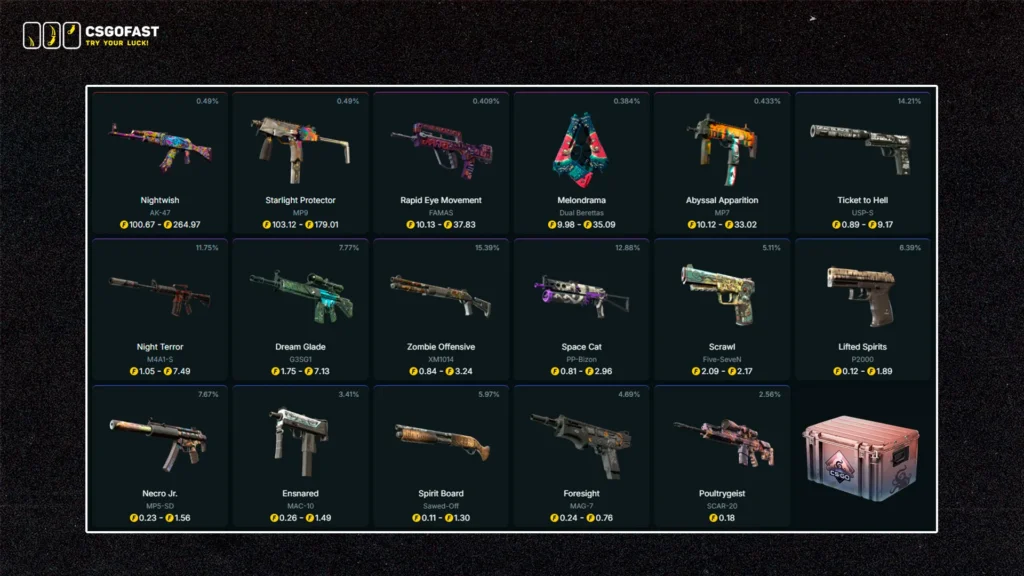
Released January 21, 2022, it was the first case assembled entirely from a community design contest: Valve set the theme – dreams and nightmares – and picked the winning entries. The result looks stranger and bolder than a standard lineup.
In the rare-special pool, Gamma finishes went to the Butterfly, Bowie, Falchion, Huntsman and Shadow Daggers, which puts an emerald Butterfly on the table as a real, if wildly improbable, outcome. The case still sits in the active drop pool, which is why it costs pocket change.
Which Case Should You Open: ROI vs. Price
The best case to open for profit potential and the best case for your budget are rarely the same one, so pick by goal:
- Maximum expected value: Chroma 2, Prisma, and Chroma 3, though expect to pay $4.50 – $7.80 per pull.
- A specific jackpot: Spectrum or Spectrum 2 for the Butterfly Knife | Doppler, Gamma or Gamma 2 for Gamma Doppler karambits, Revolution or Clutch for Sport Gloves | Vice.
- Budget openings: Kilowatt, Revolution, and Recoil stay at or under $3.00, while the Snakebite Case is the sweet spot at $3.17 with 65% ROI.
- Both at once: the Fever Case and Dreams & Nightmares Case appear in both tables, pairing sub-$4.25 prices with ROI near 70%.
Pick your goal first – best return, one specific knife, or simply the most openings for the least money – and choose the case that serves it. And if you want to start opening right now, CSGOFast has both the classics and its own sets, plus the Upgrader, Crash, Double and other modes beyond cases.
FAQ
What is the knife chance when opening a CS2 case?
Knives and gloves drop at 0.26% per opening in every CS2 weapon case, roughly 1 in 385 openings, per Valve’s official drop-rate disclosure. Covert (red) skins drop at 0.64%, about 1 in 156. The odds are identical no matter which case you open.
Do my knife odds improve if I open a lot of cases in a row?
No. Each opening is an independent event with the same fixed odds, and the game keeps no record of your streak. A thousand openings without a knife does nothing to your chance on the next one: it stays at 0.26%. The feeling that you’re “due” is the gambler’s fallacy, not a CS2 mechanic.
Can you get CS2 cases for free?
Yes. Prime-status players get a weekly care package and pick a reward from it, which usually includes a case from the active drop pool. Only the case is free, though: you still need a $2.49 key, and that key is most of what an opening costs.
Why are old CS2 cases more expensive than new ones?
Older containers like Chroma 2 and Spectrum left the weekly drop pool years ago, so no new copies enter the game while existing ones burn away with every opening. Demand for their knives hasn’t gone anywhere. Newer cases like Kilowatt still drop for players every week, which keeps their market price near zero.
Can every CS2 case be earned in-game?
No. The Fever Case and Gallery Case arrived through the Armory system rather than the weekly drop pool, so grinding matches won’t get you one. Those containers have to be bought on the Steam Community Market or from third-party services.

I write about CS2 skin gambling , focusing on how things actually work rather than how they are marketed. Most of what I cover comes down to game mechanics, risk, and the small details that people usually overlook when getting started.